
Lisa Busby had never experienced anything like it before. There she was, at a traditional Japanese tea ceremony—in Japan, no less—kneeling on a woven tatami mat, wearing a kimono. It must’ve been surreal.
“I watched as our host lady performed each step of the 点前 (temae), purifying the tools, scooping hot water, even pausing to gaze into the ladle as if it held a reflection of herself,” says Busby, who even then, as she whisked matcha into the water, recognized the rare value of the experience. “The quiet creaks of the floor, the steam rising from the tea, all of it reminded me that the moment was fleeting, and that’s what made it so precious.”
Busby, now in her junior year and majoring in biology, had travelled to Japan to study with CIEE Kyoto, taking courses like Feudal Japan and Modernizing Ancient Japan. CIEE (the Council on International Educational Exchange) is one of TLU’s affiliated programs offering summer study abroad opportunities. It was founded in the wake of World War II with a goal to advance peace by helping people understand different cultures and develop skills for living in a globally interdependent and culturally diverse world.
Kyoto, on the island of Honshu and known for its rich culture and heritage, its temples and museums and gardens, became Busby’s home away from home. And it was during the aforementioned tea ceremony that she learned a phrase she still carries with her. Ichi go ichi e is a Japanese idiom that means “one time, one meeting.”
“It signifies that every encounter, no matter how ordinary, is unique and will never be experienced in quite the same way again,” Busby explains. “This phrase truly stuck with me, as it taught me that even mundane moments hold extraordinary weight, whether it was a brief conversation with a local that made me feel welcome or the thrill of scuba diving beneath Okinawa’s waves. Both belonged to the same fleeting summer, each moment unrepeatable, all of them unforgettable.”
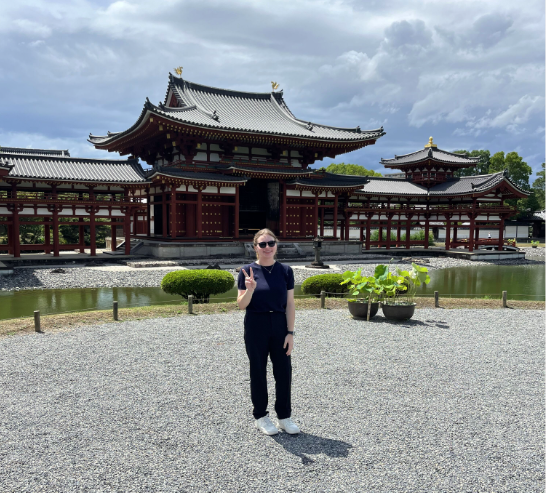
The summer carried with it all sorts of new experiences. Busby had the opportunity to see a live maiko dance in a traditional Kyoto theater. She was able to stand in the midst of the very history she was studying at Byōdō-in Temple. She walked through gardens that looked like living paintings. Side excursions carried her to Himeji Castle, the Hiroshima Peace Dome, and the red Torii gate of Itsukushima Shrine. “Each site carried its own story, its own weight, and its own reminder of how Japan weaves together past and present,” she says.
She had time for quiet reflection. “In Okinawa, I went scuba diving for the first time, floating among coral and fish in a world so different it felt almost unreal,” she recalls. “And one afternoon, sitting in a seaside cave on the most beautiful beach I have ever encountered, I realized how much joy there is in simply pausing and taking in the view.”
She got to experience the dazzling energy of Tokyo at night and the iconic glow of Osaka’s famed Glico sign. “These places pulsed with life and laughter, a complete contrast to the temples and gardens I’d wandered through days before, yet equally unforgettable.”
But in the end, it was the little everyday things that made Japan feel like home to Busby. “Ordering food in Japanese with a nervous laugh. Getting lost on winding streets and somehow finding my way back. Buying my favorite 7/11 pastries and eating all the tonkatsu, shabu-shabu, and any other Japanese dishes I could handle. Even the train stations left an impression,” she says. “At Tokyo, Kyoto, and everywhere in between, thousands of people streamed in different directions, yet moved in a flowing harmony, a quiet dance of individual purpose and mutual respect. Stepping into that flow, I felt, in some small way, like I belonged.”
To learn more about study abroad opportunities at TLU, visit https://www.tlu.edu/academics/study-abroad.