Graduate Degree
Business Administration
Choice of five specializations:
Business Analytics
Artificial Intelligence
Cybersecurity
Finance
Healthcare Administration
MBA. One Year. Online. No Excuses.
The TLU Master of Business Administration (MBA) prepares you to lead with clarity, character, and conviction. Designed for working professionals, our fully online program develops leaders who think strategically, lead ethically, and adapt confidently to a world in motion.
Through cutting-edge coursework in business and your chosen specialization, you’ll learn how to interpret complex information and lead change with insight and integrity. From managing teams to managing uncertainty, you’ll be ready.
In addition to your MBA diploma, you’ll also earn a certificate in Business Analytics, AI, cybersecurity, finance, or healthcare administration, giving you a competitive edge in your chosen field.
At TLU, your education goes beyond the classroom. With personal mentorship, a tight-knit online cohort, and a focus on long-term impact, the TLU MBA is more than a
credential—it’s a launchpad for purposeful leadership and meaningful change.
Who's it for:
- Working professionals looking to advance their careers
- Aspiring leaders who want to lead with purpose and conviction
- Individuals seeking a career with impact
What it offers:
- A flexible, fully online format for working adults
- A community of faculty and peers who share your drive
- A dual focus on data and direction—analytics + leadership
Why it matters:
- You’ll graduate ready to lead with purpose—and drive meaningful change.
- You’ll integrate your chosen specialization with business leadership.
- You’ll stand out with a competitive edge, a clear sense of mission, and the confidence to lead in any field.
Courses are 7 or 8 weeks, with 2 starts per year - fall and spring. Candidates complete
the program in 12 months (4 courses in fall; 4 in spring; 2 in summer) or there is an
option to complete the program in two years.
Specializations
-
Business Analytics
Business Analytics- MBA Specialization
The Business Analytics specialization will prepare students to analyze and make sense of data to drive decision-making. Students who specialize in business analytics gain in-demand skills like data analysis, predictive modeling, and data visualization that will help them stand out in the job market.
- Develop critical thinking, problem-solving, and leadership skills.
- Professionals with business analytics expertise will be equipped to pursue a wide range of careers in industries like finance, healthcare, marketing, and technology.
- Learn predictive modeling to forecast future trends and outcomes.
- Professionals with business analytics expertise earn and average salary of $150,000.
-
Artificial Intelligence (AI)
Artificial Intelligence - MBA Specialization
The Al specialization equips students to lead in a data-driven world. It combines strategic management with foundational technical skills, empowering graduates to bridge the gap between technical teams and business stakeholders. This low-code program focuses on ethical Al governance, decision-making, and cutting-edge business applications.
- Al job postings have grown 7x since 2012, with a 25%
- Designed for non-coders, the program teaches leaders to evaluate, implement, and manage Al in diverse business settings
- Learn to critically assess AI solutions, manage AI projects ethically, and stay ahead in a rapidly evolving field.
- Professionals with AI expertise earn an average salary of $140, 000 in managerial roles, according to PwC'a 2024 AI Jobs Barometer
Developed by Dr. Risto Miikkulainen, Professor of Computer Science. Design in collaboration with experts from University of Texas at Austin.
-
Cybersecurity
Cybersecurity- MBA Specialization
The Cybersecurity specialization equips students to lead organizations in navigating today's escalating cyber threats. This program combines strategic leadership, governance expertise, and ethical hacking techniques, preparing graduates to proactively protect digital infrastructure and respond effectively to cybersecurity challenges across industries.
- Information Security Analyst roles are projected to grow 32 % in the next decade, the business experts with cyber knowledge are set to become critical.
- Prepare for oversight roles that integrate risk management, compliance and IT security strategies, aligning with business objectives.
- Gain practical experience in ethical hacking and cyber risk management to address real-world threats effectively without the need for hardcore programming.
- Chief Information Security Officers (CISOs) earn an average of $244,565, with top roles exceeding $1 million.
Developed by Dr. Gregory Falco, Professor of Cybersecurity. Designed in collaboration with experts from Cornell University.
-
Finance
Finance- MBA Specialization
The Finance specialization prepares students to master financial decision-making, investment strategies, and cutting-edge technologies like blockchain and DeFi. With a focus on practical skills and diverse case studies, this program builds broad numeracy and strategic insight, positioning graduates for leadership roles in any industry.
- Discover how blockchain, cryptocurrencies and DeFi are transforming traditional finance, preparing students to leverage these innovations in their careers.
- Students gain hands-on experience in financial modeling, portfolio optimization, and corporate valuation through real-word projects.
- Focus on innovation and explore financial disruptions to stay ahead in a rapidly evolving field.
- Chief Financial Officers (CFOs) earn an average of $442,206, with top executives achieving an even higher compensation.
Developed by Dr. Robert Hansen, Professor of Business Administration. Designed in collaboration with experts from Dartmouth University.
-
Healthcare Administration
Healthcare Administration- MBA Specialization
The Healthcare Administration specialization equips students with the skills to lead and innovate in the fast-growing healthcare sector. From analyzing policies to managing healthcare data and finances, this program prepares graduates to solve impactful problems while thriving in diverse and lucrative roles across public, private, and entrepreneurial settings.
- Employment for healthcare administrators is projected to Healthcare Finance grow 28% by 2032 in an already massive industry.
- Data has become a primary focus in Healthcare, and leaders who drive impactful decisions and improve healthcare outcomes are in high demand.
- Designed for students with no prior healthcare experience, the program emphasizes real-world case studies, financial decision-making, and management
- For profit health system executives can earn eight-figure compensation, reflecting this sector's leadership demand and value.
Developed by Dr. Robert Hansen, Professor of Business Administration. Designed in collaboration with experts from Dartmouth University.
Program Overview
Program Details: |
|
Program Costs: |
|
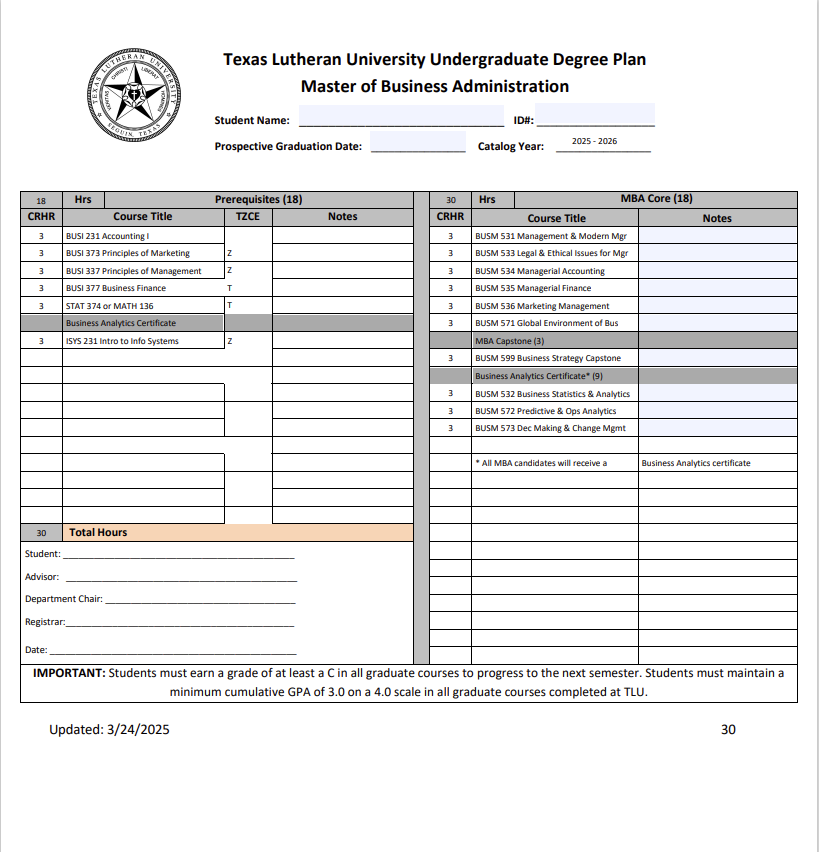
MBA Degree Plan
-
BUSM 531. Management and the Modern Manager
This course examines the theory and practice of management and leadership in emerging organizational settings which include virtual and distance environments. Traditional and modern theories of management, as well as practical application of these theories in the workplace, are explored. The course assists students to examine his/her leadership style and develop a plan to improve their skills in desired areas and environments. Additionally, the course introduces students to the technology necessary to deal with virtual teams and team members. Prerequisite: This course must be taken in the MBA student’s first semester.
-
BUSM 532. Business Statistics & Analytics
This course explores and explains the fundamentals of managerial statistical tools in descriptive and predictive analytics to aid management decision making. The course will introduce a range of data-driven disciplines to help managers make better, faster business decisions. This course will expose students to data management and business analytics principles and the tools necessary to apply them. Students will be introduced to computer software packages used in data analytics. Prerequisite: Admission to the MBA program.
-
BUSM 533. Legal and Ethical Issues for Managers
Examines the legal environment and ethical issues that impact leadership development and organizational success. Students will explore legal and regulatory environmental variables and their impact on management, decision making, and strategy formulation within the firm. This course also emphasizes both the philosophical foundations of ethical conduct and common challenges encountered by managers.
-
BUSM 534. Managerial Accounting
This course will examine managerial accounting concepts and procedures for internal reporting applied to the decision-making activities of professional managers. MBA accounting aims to teach future business leaders rather than to educate accountants, therefore this course puts more emphasis on how accounting information impacts decision-makers and less emphasis on information production. This course will provide students with an accounting toolkit and analytical skills, including data analytics, that guide them in making the complicated decisions they will face as future business leaders.
-
BUSM 535. Managerial Finance
The focus of this course is on valuation and value creation. It consists of two inter-related components: financial statements and asset valuation. It starts with a general discussion of the financial environment. It continues with the study of financial statements and a comprehensive ratio analysis of financial statements. Further, it discusses the determination of interest rates, the relationship between risk and return, and the discounted cash flow method of asset valuation, which is then applied to the valuation of financial assets (stocks and bonds) and the valuation of real assets (capital budgeting).
-
BUSM 536. Marketing Management
This course will introduce students to the organizational philosophy and set of guiding principles for interfacing with customers, competitors, collaborates, and the environment that is marketing. This course will help students develop and implement marketing strategies and understand how they underpin overall managerial operations. Students will develop a clear understanding of the basic concepts of marketing management and further understand how to make strategic marketing decisions by learning to identify the competitive advantages that result from business analytics.
-
BUSM 571. Global Environment of Business
This course will investigate international business regulation (EU, WTO, Foreign Corrupt Practices Act and similar; antitrust, fair competition law); types of cross-border for-profit entities; types of governments and their various relationships to business; effects of cultural differences on cross-cultural management structures and expectations; cross-cultural communication; cross-cultural conflict management; ethical problems arising out of cultural and legal differences, and out of environmental considerations.
-
BUSM 572. Predictive & Operations Analytics
This course is designed to equip students and professionals with the essential skills and knowledge required to analyze and leverage data for improved operations management. This course will provide students with a comprehensive understanding of predictive and operations analytics, techniques, tools, and best practices that can be applied across various industries
-
BUSM 573. Decision Making & Change Management
This course equips managers to create a culture of innovation, providing a framework for understanding how to lead people to transform business and drive change using data driven decision making. Using case studies, students will identify and analyze different types of decisions and change scenarios in business contexts while applying appropriate decisionmaking models and techniques to make informed and effective choices. Included is the process of diagnosis of under-performance, resistance to change, forecasting, managing change, communication strategies and sustaining change.
-
BUSM 599. Business Strategy Capstone
A final capstone project focusing on the formulation of strategy and policy within an organization emphasizing the integration of decisions in functional areas.
Admissions Criteria
- Applicants must already hold a bachelor’s degree from an accredited university
- Along with the application for admission, applicants must submit the following:
- Official transcripts from all colleges and universities attended
- Professional resume
- Minimum of one professional letter of recommendation
- Personal statement explaining applicant’s motivation to pursue TLU’s MBA
- Applicants must have the following academic requirements:
- Overall GPA of 3.0 in undergraduate coursework. If you do not have a 3.0 or higher, you must have a least 5 years of work experience.
- If you do not have an overall undergraduate GPA of 3.0 or at least 5 years of work experience, you must submit a GRE score of at least 283 or a GMAT score of at least 420 to be considered for admission. Note: GRE or GMAT scores must be within the last five years.
- Applicants must have completed the following undergraduate courses as prerequisites for the MBA. If you have not completed all courses, you must have completed at least three of the following six courses to be considered for provisional acceptance into the program:
- Principles of Accounting – BUSI 231
- Principles of Management – BUSI 373
- Principles of Marketing – BUSI 337
- Principles of Finance – BUSI 377
- Statistics or higher-level math course – STAT 374 or MATH 136
- Management of Information Systems – ISYS 231
Please note that equivalent courses at other institutions may have different course names or codes.
Admissions Criteria for International Applicants
In addition to the above admissions criteria, international applicants (not living in the U.S.), must provide proof of English proficiency by submitting a TOEFL score or IELTS score:
- Test of English as a Foreign Language (TOEFL) taken within the past two years. TOEFL iBT minimum score of 80; TOEFL PBT minimum score of 550; and TOEFL CBT minimum score of 213; or
- IELTS exam score of 6.5 or higher taken within the past two years
Complete Your Prerequisites Online with Peregrine Global Services
To support students lacking prerequisites or without a business background, TLU offers self-paced, online Academic Leveling Modules through Peregrine Global Services. These flexible, affordable modules cover core subjects in management, marketing, accounting, finance, information systems, and statistics, ensuring all MBA students start with the foundational knowledge needed to succeed.
Students who are directed to complete prerequisite courses will be given a registration link and password by the Associate Director for Graduate Admissions, Amber Carlton, to register for the courses they need.
Application Deadlines
Fall Application: March 1 - Early Deadline May 1 - Priority Deadline July 1 - Late Deadline | Spring Application: Oct. 1 - Early Deadline Nov. 1 - Priority Deadline Dec. 1 - Late Deadline |
APPLY NOW TO EARN YOUR MBA
Alumni Stories
NC-SARA
The National Council for State Authorization Reciprocity Agreements (NC-SARA)
NC-SARA is a nonprofit organization that helps expand students’ access to educational opportunities and ensure more efficient, consistent, and effective regulation of distance education programs.
Every student deserves a positive educational experience. Sometimes a student’s experience may not be what they anticipate, and the student may have a concern or a complaint. For this reason, NC-SARA has a process for student complaints. To learn more about this process or to file a complaint, please visit the NC-SARA website: