
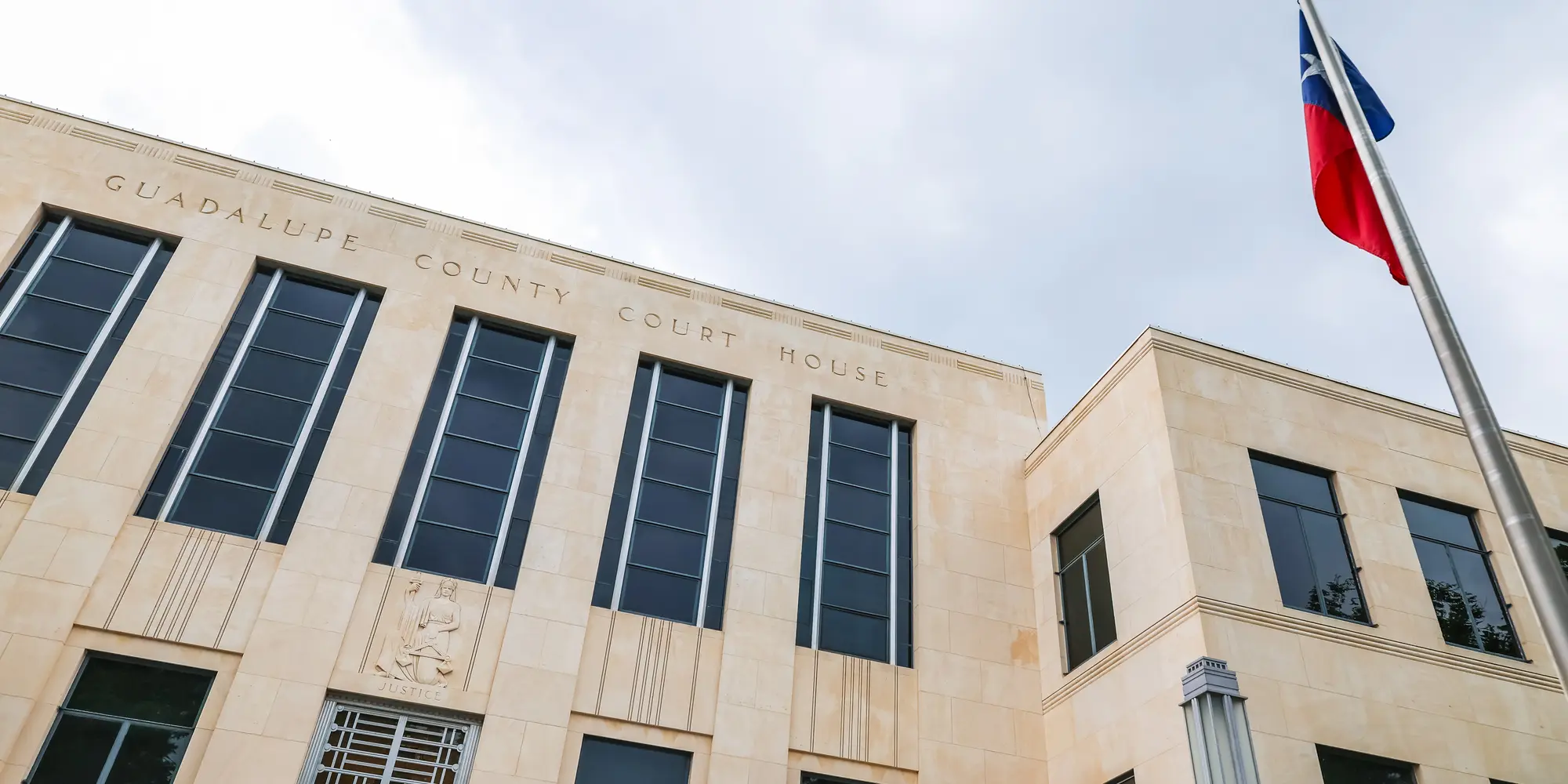
Ready to become an ethical community leader?
The TLU political science program will equip you to make reasoned decisions, to develop sound leadership practices, and to be a proactive and informed world citizen. A political science major is an excellent choice for students wishing to pursue a career in law, politics, non-profit and community organizations, management, and state and local government.

Why Political Science at TLU?
Our program is designed for experiential learning, with the TLU campus and the City of Seguin as your laboratory for developing leadership skills and becoming an engaged citizen. Seguin’s small size means that you will meet and work directly with policymakers and business professionals to address key local problems. Meeting with the mayor, reviving programs to integrate the Seguin community with campus, partnering with the city to develop public transportation infrastructure—the opportunities to develop and implement real local change in Seguin simply are not available elsewhere. At the same time, Seguin is growing, presenting new opportunities for students to leverage their expertise to make real, meaningful change in the community. We work on these civically engaged projects while developing our moral, ethical, and critical thinking frameworks. What does citizenship mean? How do we become effective leaders? You will wrestle with these questions as you apply them to your work.
Our program is accessible, with key experiential learning opportunities built right into our curriculum. Interested in legal careers and ready to develop your negotiation and public speaking skills? Our Model United Nations program is a core part of our comparative politics course. All students focus on logical reasoning and clear argumentation through individual undergraduate research projects, in class with peer support. Develop relationships with local political leaders and learn how to plan, manage, and assess complex projects through our civic engagement courses. Individualized and flexible degree plans mean that every student completes an internship and works with their advisor to customize their learning toward their vocation. Gain skills and experiences employers want that are often offered as optional or extracurricular activities, all as part of your coursework as a TLU political science major.
Want To Be More Involved?
Our majors are among the most involved students on campus, holding key positions in the Student Government Association and a wide range of clubs and organizations. They are recognized by student affairs staff as Distinguished Student Leaders and leaders of organizations winning the Student Organization of the Year Award. Our program is also home to the Alpha Mu Psi chapter of the Pi Sigma Alpha National Political Science Honor Society. Our chapter recognizes students for their outstanding achievement in political science, and membership provides students with scholarship, networking, and publication opportunities.
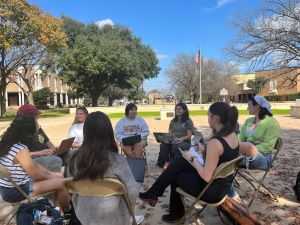
We also sponsor the CIVIC Club (Creating InVolved Students and Communities), a student-led organization dedicated to helping our majors discern what careers are best for them, to providing connections to alumni for networking and mentorship, and to fostering a collaborative environment where students support one another as they achieve their goals. Combined with faculty guidance and support, programs in the club, like law school preparation, informational interview training, and alumni speakers, ensure that our majors have developed individualized plans for success in collaboration with faculty and peers.
Students in the political science program have access to a semester-long program at American University in Washington, D.C. The Washington Semester Program gives students the opportunity to work alongside and to learn from policymakers and political leaders running our country. Students complete an internship with a government or non-profit organization in Washington and attend seminars, lectures, and on-site meetings with key decision-makers. Classes are taught by experienced policymakers and practitioners. Our partnership with American University ensures that TLU political science majors can access this program at a substantially reduced tuition cost.
Where Can Political Science Take Me?
Check out some of the places our graduates are working!
- Kane Russell Coleman Logan
- Houston Trust Company
- White & Case
- City of Lytle
- VIA
- City of San Antonio
- House Armed Services Committee
- Texas Department of Family and Protective Services
- Department of State
- United States Army
- Accenture
- CPS Energy
- McLane
- Kasasa
- Crowdstrike
- Center for the New Energy Economy, Colorado State University
Alumni Spotlights
by Adam Sanchez ’28
As a native of nearby New Braunfels, Maggie Bergeron had always felt that TLU was a comfortable, inviting community. After getting accepted and coming to campus in the fall of 2008, she knew that TLU was the place for her. Because she’d attended a smaller high school, the idea of a large university like UT was intimidating. “I was pretty sure I’d get lost in the crowd, and not in a good way,” she says, looking back. During her time at TLU, Bergeron homed in on the skills and strategies needed to step into her current role as the Metropolitan Planning Organization (MPO) Administrator for Victoria, Texas.
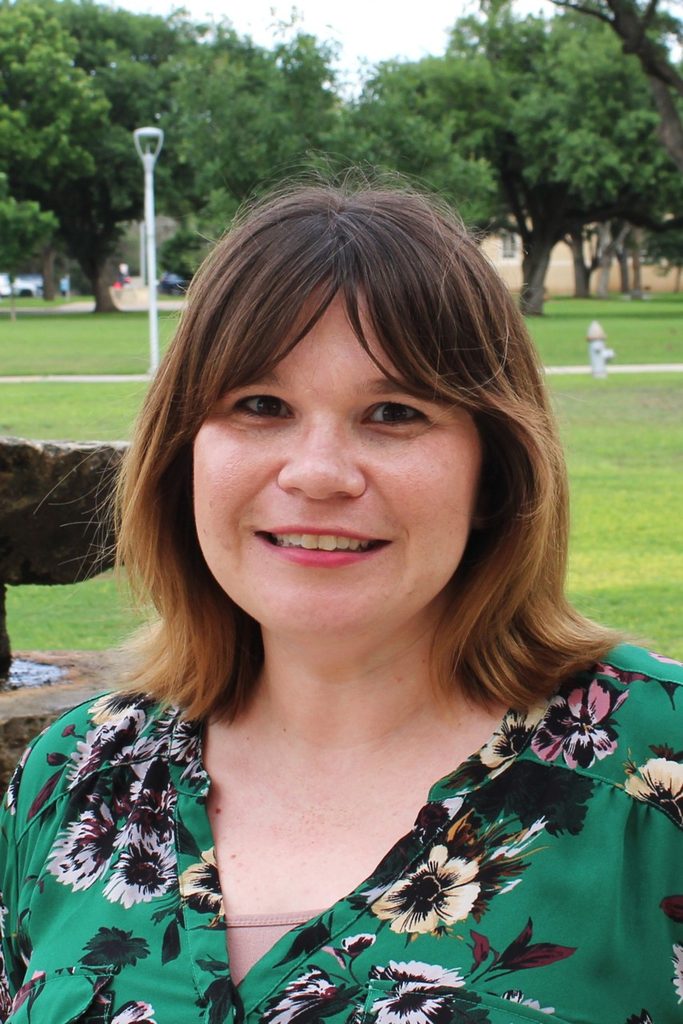
As a member of the Delta Alpha Delta sorority, Bergeron learned a lot about what it takes to be a great coordinator, between talking to people and organizing activities for the group. “I kind of knew I had a knack for creating schedules and events, getting things set up,” she says. As it turned out, she wasn’t just planning social gatherings and events for her sorority; she was learning the planning and administration practice that she would eventually utilize in her career. She learned from her successes—but even more, she learned from her mistakes. “Everyone has a different learning style, but for me, failure is the best learning experience.”
Bergeron had always found political science and analytical thinking interesting. “I was the kid who watched C-SPAN,” she says. “It’s being able to be decisive. Give me something to solve or fix. I love problem solving.”
At TLU, she took advantage of the political science major’s internship requirement by working with the City of Seguin’s Planning Department and Main Street Program. Bergeron remembers talking with Dr. Germaine Walsh, professor of political science and director of International Studies, about her internship, telling Walsh that she initially found the work to be boring. Yet she persisted, later working on Geographic Information Systems (GIS) for the City of Dallas.
That experience changed Bergeron’s perspective, and it turned out that the initial projects leading up to that work were invaluable early components in her career. At TLU, she’d learned a lot of lessons that proved priceless in graduate school and beyond. “It’s not always going to be something in your lane, but you still have to do it,” she says in hindsight. “You have to do the right thing. The diversity in learning and thinking really followed me.”
After graduating TLU, Bergeron went on to Texas State to pursue her master’s in sustainability studies. There, doing assignments was standard, but being able to bring critical thought into conversations was something that she was prepared for—thanks to TLU. “[TLU] made it much less intimidating once I got into the [graduate school] classroom.”
Now, as the regional transportation decision-making authority for an area encompassing some fifty thousand people, Bergeron finds herself doing a wide variety of tasks around Victoria. “I can go from mapping, to building a model, to budgeting, to running socio-demographics for an area,” she says. “You have to wear a lot of hats, but if you have the willingness to learn, there’s not much you can’t get done.”
To better understand transit needs, Bergeron found herself riding public transit along with commuters, asking face-to-face questions about what their thoughts were. Getting personal comments from the people directly affected by changes to public transit proved to be one of the most important types of feedback that informs her planning processes.
Sometimes things like attending events hosted at libraries, and appealing to children and their families, are parts of the job. She asks attendees how they feel about the current system, how they would feel about their children walking on area streets, and whether there might be any known deficiencies. Through experiences such as this, Bergeron has learned that public education, transparency, and meeting the people of the community where they are all make for better transportation planning.
One valuable lesson from TLU she’ll never forget: “Learning never stops. Always try to communicate and approach things on different sides.” Opportunity and discovery change the way you approach your daily life and overarching goals, but, at every step, life experiences have shaped Bergeron’s career.
Adam Sanchez ’28 is a junior communication studies major.
Marissa Back was sure she wanted to major in political science when she arrived at TLU back in 2014. She still fondly remembers her early days on campus—the excitement of moving into Baldus, the sense of possibility . . . She was a first-generation student, so the decision to pursue a college education was both a personal milestone and a significant moment for her entire family. “The prospect of leaving the comfort of home and embarking on a journey of self-discovery at TLU was both exciting and intimidating,” she says. “The sense of independence and responsibility that came with being away from home for the first time was a pivotal moment in my life.”
More than a decade has passed since those initial days at TLU, when Back set out to earn her degree in political science. As it happened, she was caught off guard by another class that first semester. Through a twist of fate, she ended up registering for Dr. Boehm’s Intro to Sociology class. “I recall several conversations I had with my mom a few weeks into the Intro class, where I expressed my interest in the subject and desire to learn more about it.”
Back enjoyed the coursework so much, in fact, that by the fall of 2015, she’d decided a double major was the right fit—allowing her to study both political science and sociology. She says she was “inspired by Dr. Boehm’s infectious passion for the subject and his ability to engage even the most skeptical students. His enthusiasm fueled my desire to dive deeper into the dynamics of society from a sociological perspective.”
Back’s concentrations were in pre-law and criminal justice. “I found that the courses for each complemented the other. This didn’t make double majoring easy, by any means. The readings were often dense and demanding, while drafting briefs in Constitutional Law proved to be particularly demanding.” She learned to balance her studies with the rest of her life and leaned on her professors for extra support. “Throughout my time at TLU, I had the fortune of being mentored by exceptional professors such as Dr. Boehm, Dr. Walsh, and Professor Dillingham, among many others,” she explains. “I delved into courses on social inequality, political theory, research methods, and more, all of which equipped me with the knowledge and skills necessary to navigate the complex landscape of our society.”
Before long, it was 2017. Back was preparing to graduate and looking toward her future, contemplating her choices beyond TLU. “After graduation, I knew that I wanted to use my education to make a tangible impact on the world around me,” she says. Logically, law school seemed like the next step, so she applied to law schools and set about waiting to hear back from them. “During this period of uncertainty, I did what every bored and broke young adult did and started looking on Google for jobs where I could use my degree,” she remembers. “I thought, while I wait for law school maybe I can get some work experience, other than internships, under my belt.”
And that was when she stumbled upon the alarming and all too prevalent issue of elder abuse. “I discovered that only one out of every twenty-four cases of elder abuse is reported and for financial abuse it’s only one out of every forty-four,” she says. “Seeing the stories of vulnerable seniors suffering in silence really hit my heart, and I knew that I had to take action to help.”
It wasn’t long before Back heard from law school, by the way. She got in. But by that time, she’d launched her career with Family and Protective Services, where she is now an Evidence Driven Investigations Subject Matter Expert. “Fighting elder abuse just seemed more like my cup of tea—plus, the elderly have way better stories than textbooks,” she says.
“I am humbled by the realization that the lessons learned at TLU have not only shaped my academic pursuits but have also guided me toward a purpose-driven career path,” she says, tracing the journey she’s been on since graduation. “Though the journey has been challenging, filled with heartache and frustration, it has also been filled with moments of triumph and hope. I am privileged to stand as an advocate for those voiceless individuals, utilizing the knowledge and skills acquired at TLU to drive impactful change.”
It’s a long way from Kosovo to the United States—just over six thousand miles and across an ocean from the capital city of Prishtina, Kosovo, to Seguin, Texas. And yet, back in 2006, Getoar Mjeku made that journey. He came to attend Texas Lutheran University.
It’s also a long way from being a brand-new college freshman to becoming deputy minister of economy of the Republic of Kosovo, not to mention a respected lawyer, writer, and father of two. But that’s another journey Mjeku has made in the fifteen years since he graduated.
This month he circled back to TLU to touch base with friends and professors and to present TLU President Debbie Cottrell with a gift expressing his gratitude to the university—a piece of quartz from Kosovo and a book he’d translated into English during college.
But back to the beginning of the story: Mjeku was born in Prishtina, Kosovo in the late 1980s—he would’ve been about ten years old during the Kosovo War, and in his early twenties when Kosovo was finally able to declare its independence in 2008.
He was, in fact, a student at TLU when that happened. He was one of fifteen Kosovar students who attended the university between 2002 and 2014. (The first to arrive was Faton “Tony” Bislimi, who then petitioned TLU to support his compatriots.)
Mjeku came to TLU by way of a generous scholarship sponsored by Ann Saegert and Bill Adams. He’d been valedictorian of his graduating high school class—could probably have taken his pick from a wide selection of universities. But Mjeku chose TLU for the very same reasons that generations of students have done the same. “It was certainly the liberal arts program, and the expectation that you would get the personalized attention that you needed,” he says. “And that’s exactly what I got here.”
Mjeku flourished in college, as did others in the group from Kosovo. Sure, there were twinges of homesickness—not to mention the challenge of getting used to the South Texas climate. But for the most part, any sense of culture shock was actually a positive thing. “People were very welcoming,” he says, explaining that the students were encouraged to tell their stories and to talk about their homeland, “which encouraged us to speak incessantly,” he adds with a laugh, “but also led us to care more about home.”
Mjeku keeps in touch with his fellow Kosovar classmates. “Many of them have gone on to build successful careers in IT, finance, automotive, and other industries,” he says. And Mjeku himself? “I pursued my long-term dream of becoming a lawyer and returning home to Kosovo.”
The terms of his scholarship called for a promise to take what he learned back home after graduating, but Mjeku wouldn’t have had it any other way, promise or no. It was his dream to carry the lessons he learned back to his country. “I was inspired to share what I’d witnessed here,” he explains. “Your dedication to the community here, your patriotism, helped me love my country more. I wanted to follow that example.”
Mjeku received his bachelor’s degree at TLU in 2010. He spent the following year in Washington, D.C. working as a broadcaster for Voice of America, an international broadcasting network funded by the federal government. Then he headed to Dallas for law school at Southern Methodist University. All the while, Ann Saegert and Bill Adams, the couple who’d sponsored his undergrad scholarship at TLU, still kept up with him, offering encouragement at every stage. “To this day, they still check on me,” he says.
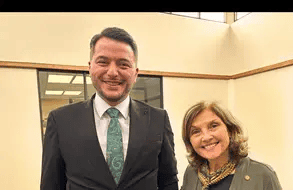
So Mjeku became a lawyer in Texas, then returned to Kosovo as he’d promised he would. With him, he carried a new perspective and countless life lessons. “As alma mater, nourishing mother, Texas Lutheran University helped prepare me academically, socially, and emotionally—all three—to make a difference in my own life and in the lives of others anywhere I went.”
That preparation included experiences like theology classes with Dr. Norman Beck. Mjeku remembers that Beck had his students learn about and experience different religions, took them to a mosque, to a synagogue, to a Buddhist temple, “he really taught us that there are ways to make room for everyone. The theologies seem conflicting, but they can all serve a common purpose for humanity.” Mjeku walked out of TLU with the understanding that various philosophies and ideologies don’t have to be reconciled—that they have far more in common than what separates them. And that broadened his thinking, which, of course, is exactly what a liberal arts education is all about.
“In my work, in my life, I often look back to my time at TLU and draw inspiration from the lessons I learned and the memories I created here,” he says. “TLU taught me to embrace diversity and cooperation and to believe that the success of one person could be the success of others.”
Those lessons came in handy as Mjeku’s career evolved. He went from practicing law to becoming Kosovo’s deputy minister of industry, entrepreneurship and trade, and is now serving as deputy minister of economy in “a government that is dedicated to improving the rule of law, growing the economy, and promoting social justice.”
The path into politics, while not necessarily on Mjeku’s original agenda, was a natural progression. “I was always interested in public affairs,” he says. “I would have people ask me whether I intended to go into politics. My answer has always been that I will choose whatever job can make a difference.” He chuckles, saying that sounds like something a politician would say. “But I mean it.”
Studying law in a foreign country and then transitioning back home gave him unique tools to help in ways others could not, and he points to TLU again for equipping him for the journey. “I saw an opportunity to do more in politics by bringing the experience I had and the values nurtured at TLU.”
Looking back on his undergrad years, he says it’s hard to pick a favorite memory. “It’s probably the celebration we put together on the day Kosovo declared its independence,” he says, remembering how the campus came together to share the joy with the Kosovar students. “We were happy to see our people achieve their long-term goal—independence—but we were also delighted to share our story and our celebration with friends here. We all celebrated together.”
Returning to the campus that holds so many memories, that he still credits with changing the trajectory of his life for the better, Mjeku spent his day at TLU revisiting faces from his past and meeting new people, noticing what has changed, and what hasn’t. “I’m happy to visit Seguin after so many years and to see old friends and professors and to witness TLU’s growth as an institution and as a community,” he says. “I’m very pleased to see the expansion and addition of academic programs that will have a tremendous impact on local communities and beyond.”
He’s not just saying that—about the impact a university can have and how that impact is carried forward by students into the larger world. It’s the truth, and Mjeku—a man who has championed his people and cherishes diversity and freedom, who works one day at a time to make his world better through service—is living proof of that.
JaKayla DaBera’s mother was right—as mothers usually are. It was 2014, and DaBera and her parents had come to TLU for a campus visit. “My mother turned to me and said, ‘You’re going to take over this campus,’” she remembers. At the time, DaBera didn’t take the remark as a compliment. “As an eighteen-year-old, full of angst and attitude, I was immediately offended,” she recalls. “Was she trying to say that I’m a control freak? I immediately blurted out in a tone, ‘What’s that supposed to mean?’ My mom just looked at me and said, ‘JaKayla, you’re you. This is a small campus. You’re going to be involved in everything.’”
DaBera gave a huff and said, “Whatever,” and left it at that. But ah, the wisdom of her mother. “Over my four years at TLU, I was involved in everything,” she admits—as in, the Black Student Union, the honors program, Student Government Association, Alpha Lambda Delta, Alpha Chi, the Mexican American Student Association . . . She was a resident assistant and a member of the prestigious Black and Gold President’s Council. She did a semester in Washington, taking on an internship for Congressman Lloyd Doggett. So yep, her mother was right. “That level of involvement taught me so many lessons. Lessons that carried me through law school and that still carry me to this day.”
After earning her bachelor’s degree in political science and sociology in 2018, DaBera went on to attend law school at Emory University School of Law, earning her JD in 2021. She is now an associate attorney at Kane Russell Coleman Logan in Dallas, focusing her practice on bankruptcy litigation.
“Law school wasn’t easy,” she says. “As a first-gen student, there was so much I didn’t know or didn’t think to anticipate. The lessons I learned at TLU helped me through those law school uncertainties as they formed a rock-solid foundation.”
Her most valuable lessons from her undergrad years? She learned the importance of community and surrounding oneself with strong, supportive friends. “I’m still friends with some of the people I connected with at TLU,” she says. “Those are some of my strongest relationships. Knowing how to make friends and the right friends to make was crucial to my survival in law school.” DaBera says her first semester at Emory was a bit shaky, but with the help of four friends, she got through it. “Four amazing women pulled me out of my bed and pushed me through a final studies bootcamp,” she remembers. “When I needed support in any way, those ladies showed up for me.”

The second lesson of her undergrad years was how to cultivate resilience. “I come from a pretty tough background,” she says. “Prior to attending TLU, I understood what resilience in the face of personal struggle meant, but not really when it came to education. At TLU, I learned that it was important to advocate for yourself in the classroom and to challenge your way of thinking.”
She also learned how to embrace being underestimated and how to conquer fears. “TLU created the perfect environment for me to learn and grow,” she says. “I had to step out of my comfort zone many times.” Her willingness to walk into the uncomfortable and unknown, rather than avoid it, fostered the courage she would need to go to law school eight hundred miles from home—and to stick with it. “I didn’t give up when things got difficult. I remembered my grit, my support system, and saw my journey through to the end.”
And finally, she learned how to manage her time and balance competing obligations. “TLU gives you the unique opportunity to be over-involved,” she says. Sounds like a bad thing, right? But DaBera saw it as a gift. “This forces you to prioritize, take control of your schedule, and create opportunities for self-care.” She had to be able to balance her many obligations if she was going to keep up in law school, and in life.
Law school, as it turned out, was a great testing ground for the lessons she’d learned at TLU. And the lessons held true, if her performance there is any indication. A few of her accomplishments: She was a 2019 Leadership Council on Legal Diversity Scholar and secured a spot as a Larry D. Thompson Fellow. She interned for PepsiCo. She was recognized as a top 10 percent oral advocate and in the Order of Emory Advocates for Outstanding Achievement in or Contribution to Excellence in Advocacy Activities. She was on the dean’s list in the spring of 2021, and that same year, participated in the National Student Trial Advocacy Competition.
Now, as an attorney, DaBera says she’s still relying on those TLU lessons, especially when the days are long. She’ll even have moments, as most attorneys do, when she questions whether this is what she’ll do for the rest of her career.
“Don’t let that scare you,” she advises up-and-coming attorneys. “Being a lawyer, a servant-leader, is truly a rewarding privilege. Just don’t forget to rely on your own lessons or principles formed at TLU.”
Our Work
Dr. Germaine Walsh, TLU professor of political science, sociology, and geography, understands the value of being informed and making connections—and one of the ways she delivers that to her students is by taking them to the annual Texas Legislative Conference held in New Braunfels.
“I bring my students to the Texas Legislative Conference because the panel discussions focus on the most pressing issues being considered in this legislative session,” said Walsh. “In addition, many of the attendees are leaders within the city and county governments that are also part of our study this semester.”
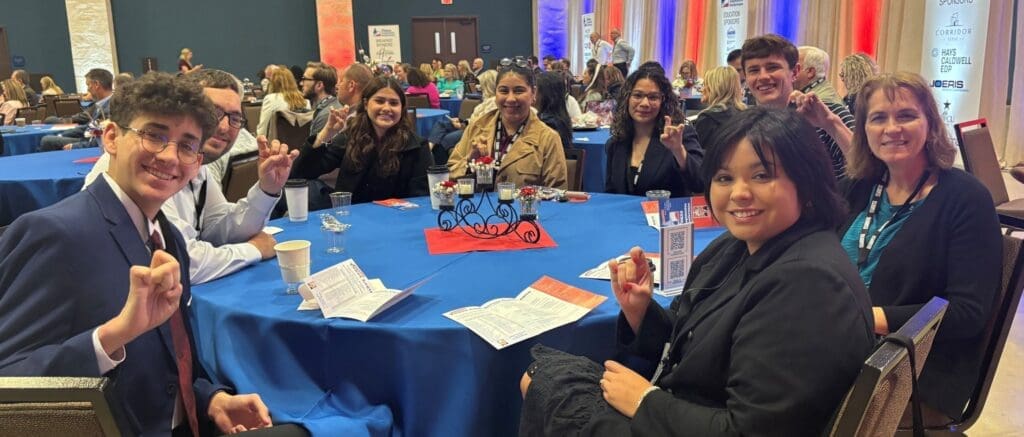
This year marks the 59th anniversary of the conference, which took place in March, bringing some 350 attendees together including state and industry leaders, there to foster discussions on the key legislative issues that shape the state. Topics of discussion included the future of Texas schools, the idea of legalizing gaming in Texas, and the state of Texas’ infrastructure, encompassing roads, water systems, and the energy grid, and the challenges that arise as the population continues its upward trend.
Eleanor Puchot, a senior political science major at TLU who attended the conference, enjoyed the experience. “I found it incredibly valuable to witness civic engagement and education in action,” she said. “Watching how this conference took the initiative to inform local communities about the recent developments in the Texas Legislature gave me a deeper understanding of the importance of public participation.”
Puchot said the conference reinforced the value of involvement at the local level in state determination. “From this experience, I have learned about the crucial impact that community involvement plays in shaping policies and holding governing bodies accountable. Staying informed about local and state decisions is vital for anyone living within the communities impacted by them. I hope to use this opportunity as a stepping stone for future endeavors in community and government engagement.”
Interdisciplinary conversations are a critical component of the humanities and social sciences. Students and faculty recently gathered to celebrate interdisciplinarity with short presentations on topical issues. The event was created by Allegra Negrete, a junior political science major who serves as president of the CIVIC Club. “CIVIC Club stands for creating involved individuals and communities,” said Negrete. “We are an organization that aims to recognize and foster conversations among students and faculty in the humanities and social sciences. Our disciplines and career paths often lead us to work across boundaries and to explain scholarship to a range of stakeholders. This student scholarship showcase event helps to celebrate our interdisciplinarity.”
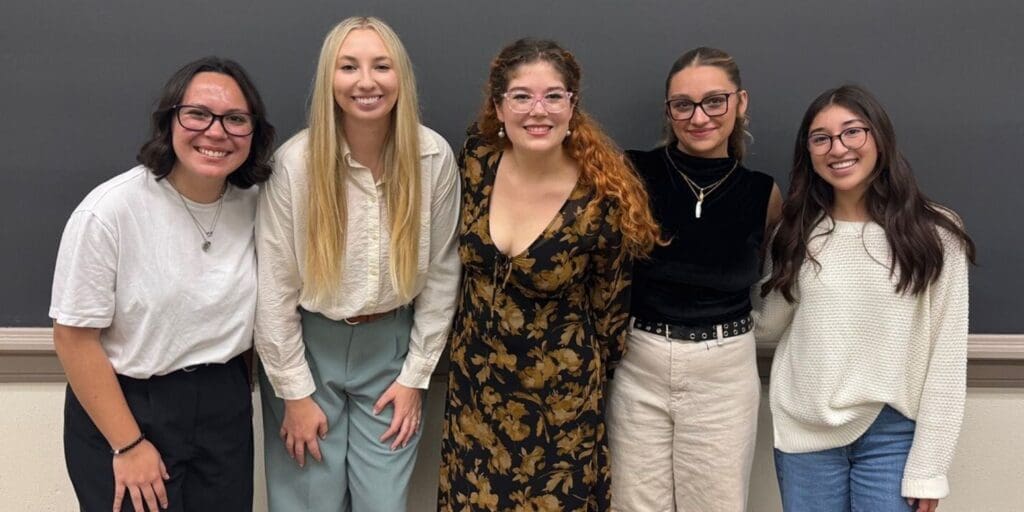
The event featured presentations employing a range of methodologies and approaches from students in all stages of their TLU careers. Isabelle Stephens, a junior sociology major, presented her capstone project collecting and analyzing state-level quantitative data on K-12 school shootings and the enactment of different gun policies. Sophia Short, a senior psychology major, described how beauty filters on social media shape users’ self-perceptions and perpetuate stereotypes about how beauty is defined. Elise Davis, a freshman art and history double major, discussed her historical investigation into the importance of women’s cycling attire for social progress in the 1980s. Hallie Strange, a junior dramatic media major, spoke about how TikTok is designed to blend online social engagement with commerce.
A lively informal discussion identified common themes, emphasizing how each of the presentation topics drew on the concept of mobilizing the collective to produce societal and/or policy change. “It was great to better understand how different disciplines approach and study similar concepts and themes,” said Negrete. “We plan to organize a similar event next year to continue to foster these kinds of thought-provoking conversations.”
In the spring of 2024, TLU organized its own chapter of Pi Sigma Alpha, the national honor society for students of political science in US colleges and universities. That chapter, Alpha Mu Psi, inducted its first members in April of 2024, and included students of sociology and geography in addition to political science. The club operates in conjunction with the TLU CIVIC (Creating Involved Individuals and Communities) Club.
Now, less than two years later, Pi Sigma Alpha has named Alpha Mu Psi a recipient of a Best Chapter Award for 2024-2025.
“This recognition is the result of the vision and hard work of our students,” said Dr. William O’Brochta, Assistant Professor of Political Science and TLU Pi Sigma Alpha chapter advisor.
O’Brochta says it was the students who approached him with the idea of establishing a chapter of the honor society on campus while also creating a club that supports all students interested in political science, sociology, geography, and related career paths. The goal was to increase student community, to provide resources for vocation discernment and career development, and to recognize exceptional student work.
“In just two years, the CIVIC Club and Pi Sigma Alpha honor society have started a series of new community-building events, including opportunities to build community with faculty and students, and led our first interdisciplinary scholarship showcase with student research presentations,” said O’Brochta, who credits the students with the club’s success. “It is very challenging to start and to lead a new organization on campus. Our student leaders, president Allegra Negrete, vice-president Madison Wright, and past vice-president Ainsley Davis, have been instrumental in designing and subsequently creating an organization that supports political science and sociology students alongside students in the broader humanities and social sciences.”
Best Chapter Awards recognize local chapters of Pi Sigma Alpha that are particularly active in their institutions and communities to embody the society’s mission and stimulate scholarship and intellectual interest in political science.
Major in Political Science for a Bachelor of Arts
Designed for students interested in careers that utilize law, our pre-law program teaches the critical reasoning, logic, and advanced writing skills you need to apply to law school or to work in the legal field. Students with pre-law concentrations benefit from access to local legal internship networks, faculty pre-law advising, and courses designed to expose students to legal research and writing in a small and supportive classroom environment.
Our individualized advising approach helps match students’ career and life goals with their career plans. We place students at some of the highest ranked law schools in the nation, including Georgetown University, Washington University, Emory University, Arizona State University, and The University of Texas at Austin. We also help students who want to practice in Texas join local legal networks that help them gain admission and maximize scholarship opportunities at institutions like the University of Houston, Southern Methodist University, Texas Tech University, St. Mary’s University, and others. Our students work in private practices, in firms of all sizes, and at the national level as Chief Legal Officers, Judge Advocates General (JAG), and state attorney positions.
Our pre-law program is not just pre-law school. Our students are successful in legal related careers with titles like Senior Contracts Administrator, Vice President of Trust Administration, and paralegal. Interested in law? We help you discern your legal path.
The TLU public policy and administration program combines hands-on, experiential learning with a strong local network of alumni public policy practitioners. Many of our students convert their internship experience in local government into full-time positions. These positions often sponsor students to earn master’s degrees, especially in public administration and public policy. We have relationships with graduate Master of Public Administration (MPA) and Master of Public Policy (MPP) programs for students looking to apply to graduate school. Our standalone courses in public policy and in public administration help to better prepare and to distinguish our students for these opportunities.
Our students are key administrators in state and local government, including positions such as Director of Community Development, Emergency Management Program Manager, Chief Legal Officer, Associate Commissioner, and Director of Judicial Services. At the national level, these positions include Contracting Officer and Assistant Chief of Budget Formulation. Our students also work for public policy organizations in roles like Senior Manager of Public Policy and Senior Policy Advisor.
Interested in working for elected politicians? TLU alumni staff politicians and committees in positions on the House Armed Services Committee and in roles such as District Director, Digital Media Manager, Chief of Staff, and Director of Constituent Services.
View the Degree Plan for Political Science (Public Policy & Administration B.A.)
Our courses in comparative politics and international relations are some of the primary ways that students from all majors can explore the world while at TLU. With a focus on contemporary political issues, courses on political economy, the politics of development, and the consequences of war and peace challenge students to consider how political life is and should be structured.
TLU faculty work to expose students to new ways of thinking and organizing political institutions, which often inspires them to study abroad. Our International Studies program helps make study abroad possible by providing students with baseline cultural and political knowledge to prepare them for a study abroad experience, and managing financial costs so that study abroad is attainable and affordable. We work closely with our Study Abroad office to assist political science students in selecting programs where they can experience the political world through different perspectives. They may thenn translate that experience into work as a Foreign Service Officer with the U.S. Department of State or other positions abroad.
View the Degree Plan for Political Science (International Politics B.A)
TLU political science majors learn the leadership, decision-making, and critical thinking skills that private sector employers want. We help our students articulate these experiences so that they are competitive for a wide range of positions, especially those in management and leadership. Political science helps you learn to be a better leader, using your power and influence effectively, ethically, and purposefully. Leverage your political science degree for leadership positions as a Project Manager, Assistant Director of Marketing, Logistics Analyst, Systems Analyst, and Project Coordinator.
View the Degree Plan for Political Science (Liberal Arts B.A.)
All our political science majors conduct individual undergraduate research projects as part of their capstone experience. The size, scope, and individualized nature of these projects helps to distinguish our students on the job market. TLU faculty mentors help students develop project ideas that link directly to their intended career goals, enabling them to explore research opportunities that can then translate into newly learned skills for job applications and personal statement experiences for graduate school.
We define research broadly and provide our students with tools to conduct qualitative interviews, quantitative statistical work, and legal research and writing. With small class sizes, students can easily work directly with faculty on their own research, or collaboratively with faculty on co-authored projects. Students also benefit from faculty connections to the broader political science discipline that enable them to work on research articles for publication in scholarly journals, to learn professional skills in the discipline, and to organize and present at conferences.
Our students use their political research experience in their careers and as preparation for graduate school, earning graduate degrees in National Security Studies, International Relations, Applied Intelligence, Conflict Resolution, and political science, among others.
View the Degree Plan for Political Science (Political Research B.A.)