

Physics at TLU
Physics is the most fundamental of all the natural sciences, aimed at understanding all parts of the natural world. In fact, the word “physics” stems from the Greek word phyusika, which translates to “natural things.” Students in physics degree programs learn the basic principles that govern the natural world and how to extend and apply those principles to solve new problems through experiment and mathematical analysis.
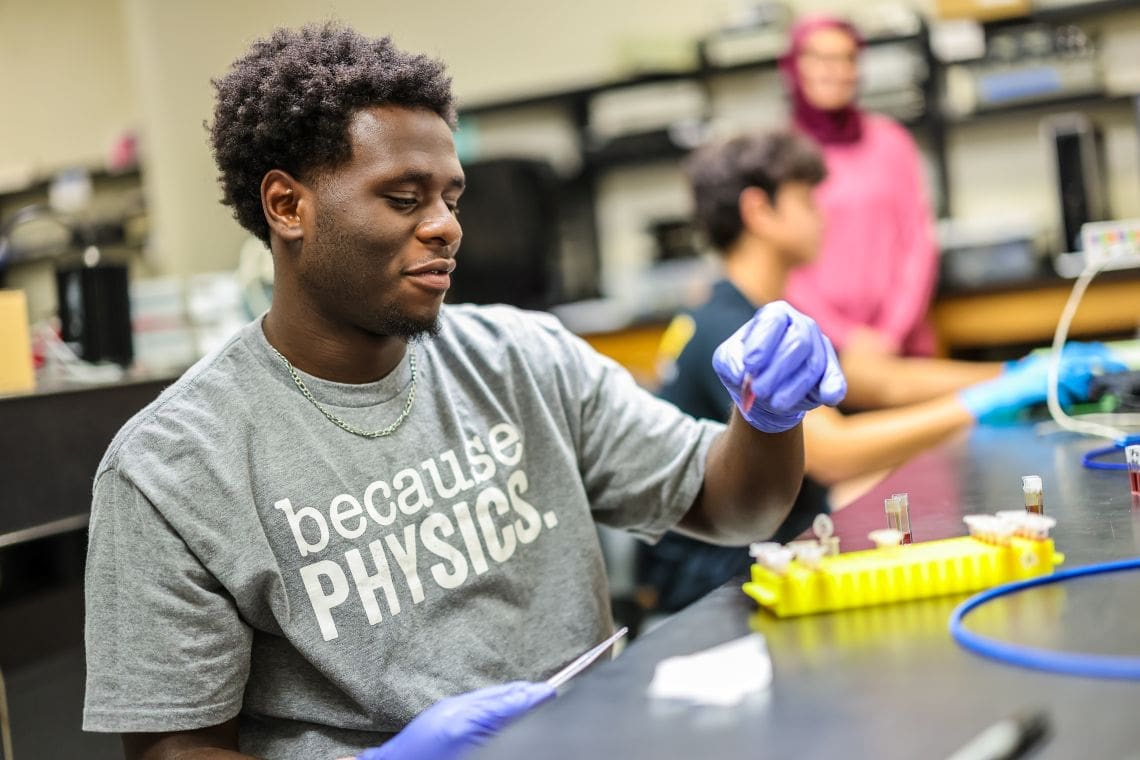
Small class sizes and a dedicated faculty allow TLU Physics students to thrive and grow as learners. Introductory laboratories are designed to bolster both content knowledge and practical skills. Several advanced labs, including a unique computational methods course sequence, allow students to hone experimental and computational skills. Students are encouraged to participate in faculty-mentored independent research early on, and all students are required to complete a senior capstone research project. As part of the complete undergraduate experience, all students are encouraged to seek out one of many summer research or internship opportunities that host physics students around the U.S.
Students in physics are curious about how the universe works from the nano-scale interactions of biological systems to the mysteries of dark matter. At TLU Physics, our attention to the individual student allows that curiosity to manifest in a variety of ways, accommodating a vast range of career goals. Students with degrees in physics work in any field which values critical thinking skills, mathematical dexterity, analysis, and creative problem-solving. You will find physics degree holders in all areas of science and technology-related careers, as well as business, medicine, law, and even economics.
At TLU, physics students meet the challenges of understanding the natural world with small introductory classes, hands-on laboratory experiences, and an active student-centered learning community. The TLU Physics faculty is committed to providing an engaging curriculum in the classroom, and faculty-mentored, open-ended research opportunities outside the classroom. Our unique computational physics sequence includes instruction in widely used software applications for modern engineering and applied physics, including MATLAB™ and LabVIEW™. Students will participate in the broader professional scientific community in Texas and around the U.S. by attending regional and national scientific meetings.
Why Physics at TLU?
Physics: Your Pathway to Engineering & More
Interested in engineering? TLU’s new BS in Applied Physics with optional pre-engineering concentration may be the degree for you. Check out the fact sheet to learn why you should majors in physics, the advantages of a physics bachelor’s degree, and all the career opportunities it can lead to.
Natural Science Course Offerings
Designed for non-math, non-science majors
- Summer A: PHYS143: Physics of Modern World Issues (with lab)
- Summer B: PHYS144: Conceptual Physics (with lab)
- Fall Term: PHYS143: Physics of Modern World Issues (with lab)
Dual Degree Engineering Program
TLU is an official affiliate of the Washington University (WashU) McKelvey School of Engineering in St. Louis, Missouri. Our students study at TLU for three years in the Bachelor of Science in Applied Physics program, then spend two years at WashU to complete both the bachelor’s degree in applied physics and a bachelor’s degree in engineering in one of nine engineering majors including:
- Biomedical Engineering
- Chemical Engineering
- Computer Engineering
- Computer Science
- Data Science
- Electrical Engineering
- Environmental Engineering
- Mechanical Engineering
- Systems Science & Engineering
TLU students choosing this option will complete a minimum of 100 credit hours at TLU with a cumulative GPA of 3.25 in math and science coursework.
Students from affiliate schools are also eligible to receive a discount for the January Intensive Term (J-Term), a special 11-day intensive format where students study and live together and get a head start at building connections before enrolling as dual degree engineering students.
For information on how to apply, admissions criteria, application deadlines, financial aid, housing, and WashU’s J-Term, visit engineering.wustl.edu/dualdegree
What to Expect
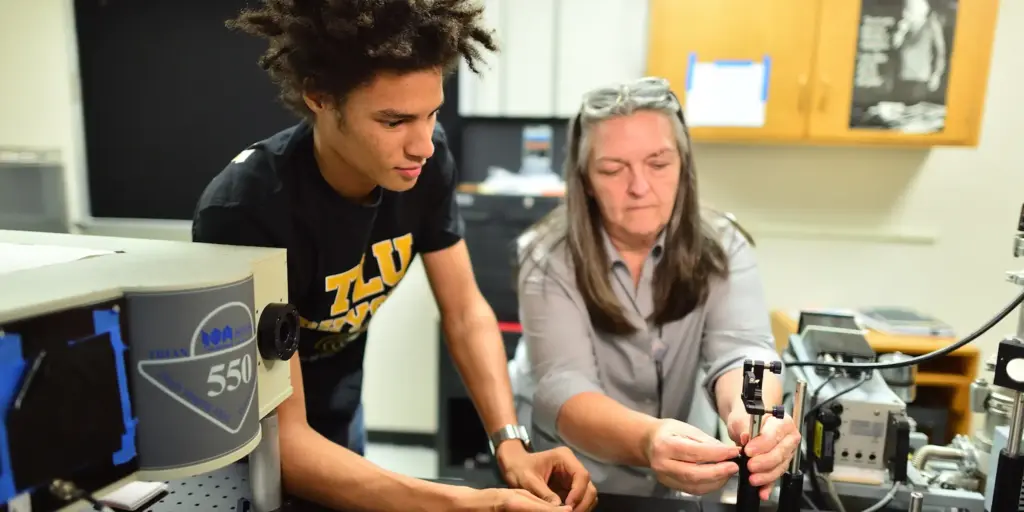
TLU Physics students are encouraged to explore faculty-mentored research opportunities in the first year of their physics experience. Our advanced lab courses hone the experimental skills needed to carry out more advanced laboratory work, while our computational methods courses provide the software foundations that are common in many laboratory settings. Laboratory work leads to the senior capstone experience where students work on a year-long (or more) independent project with a faculty mentor that culminates in a senior thesis and presentation at a professional conference. TLU students are active in state- and national-level professional scientific meetings.
Students are encouraged to explore the wide range of summer opportunities offered by universities and industrial companies around the U.S. TLU students have participated in research at Texas A&M University, University of Pennsylvania, University of Nebraska-Lincoln, Duke University, and University of Florida, among others. Participation in research at other institutions or companies can be used as the basis for the senior capstone research work.
Excelling in physics requires development and expertise in a very broad skill set. Combined with the liberal arts education at TLU, the physics department provides graduates with a highly employable blend of skills, such as problem-solving, computer programming, experimental design, technical writing, oral presentation, independent research, and teamwork. Many professions rely on these skills, which is why they are the very foundation of the physics curriculum. The American Institute of Physics reports that in 2008, a survey of starting salaries offered by campus recruiters to students graduating with a bachelor’s in physics ranged from $40,000 to $64,000.
Here is a small sampling of the kind of careers physics majors might pursue upon completing their bachelor’s (statistics from the AIP website):
- Academia: As of 2007, about 35 percent of students with bachelor’s degrees in physics went into graduate school in physics or astronomy. For most physics graduate programs, schools pay tuition plus a stipend (actual numbers can be found at gradschoolshopper.com). In return, students are expected to research and/or be a teaching assistant. A master’s in physics typically takes two to three years, while a PhD in physics takes about five to six years.
- Medical School: Students with a degree in physics routinely score higher than biology majors on the MCAT, the entrance exam for medical school. Students wishing to go to medical school with a physics degree are strongly urged to minor in biology.
- Engineering: This is the largest field of employment for physics majors. The problem-solving skills developed through coursework in physics are highly sought after in this field.
- Consulting: Many companies hire consultants to assist in solving problems with their company. The development of problem-solving skills for a physics major makes this an ideal match.
- Law: Physics majors are continually the top-scoring major on the LSAT, the entrance exam to law school. Many companies hire physicists to be expert witnesses when scientific information needs to be explained to a jury.
- Teaching: There is a need for high school physics teachers. In 2009, only 35 percent of high school physics teachers had a degree in physics or physics education. Increasing the number of high school teachers with an interest in physics will increase the morale, perception, and prestige of the field.
Excelling in physics requires development and expertise in a very broad skill set. Combined with the liberal arts education at TLU, the physics department provides graduates with a highly employable blend of skills, such as problem-solving, computer programming, experimental design, technical writing, oral presentation, independent research, and teamwork. Many professions rely on these skills, which is why they are the very foundation of the physics curriculum.
TLU Physics has a nationally recognized chapter of the Society of Physics Students (SPS). SPS is a national organization devoted to the enhancement of the undergraduate physics experience. The TLU SPS chapter serves as the hub for community building and professional development within the department of physics through strong student leadership and dedicated faculty support.
The TLU SPS meets weekly on Tuesdays at lunchtime. Each meeting includes a program aimed at enhancing the curricular experience of students and provides an opportunity for students to self-determine the function and activities of the group. The TLU SPS chapter leads the department in a number of civic engagement and community outreach projects, including the annual Family Physics Night event, which brings over 300 visitors to the TLU campus for a public physics lecture, physics demonstrations, and interactive physics activities. All students are encouraged to become active members of SPS.
Annual Family Physics Night
Since 2013, the TLU physics department and SPS have invited families and aspiring physicists of all ages to campus for live interactive demonstrations of the basic principles of physics. This serves as a fun, educational night for prospective students to learn more about the physics program at TLU and to get great ideas for science fair projects.
The evening kicks off with the SPS Public Lecture in Physics followed by refreshments at the Jackson Park Gazebo. Before heading into the Jackson Park Student Activity Center, participants get to witness an explosive Phenomenal Physics Demo Show. Then they enjoy a variety of interactive, hands-on stations packed with fun activities for scientists of all ages.
Previous guests include Dr. John Nilesen-Gammon, NASA Flight Engineer Dr. Renee Horton, Deputy Director of the Exploration Integration and Sciences Directorate at NASA Ginger Kerrick, and Dr. Frances Slakey.