
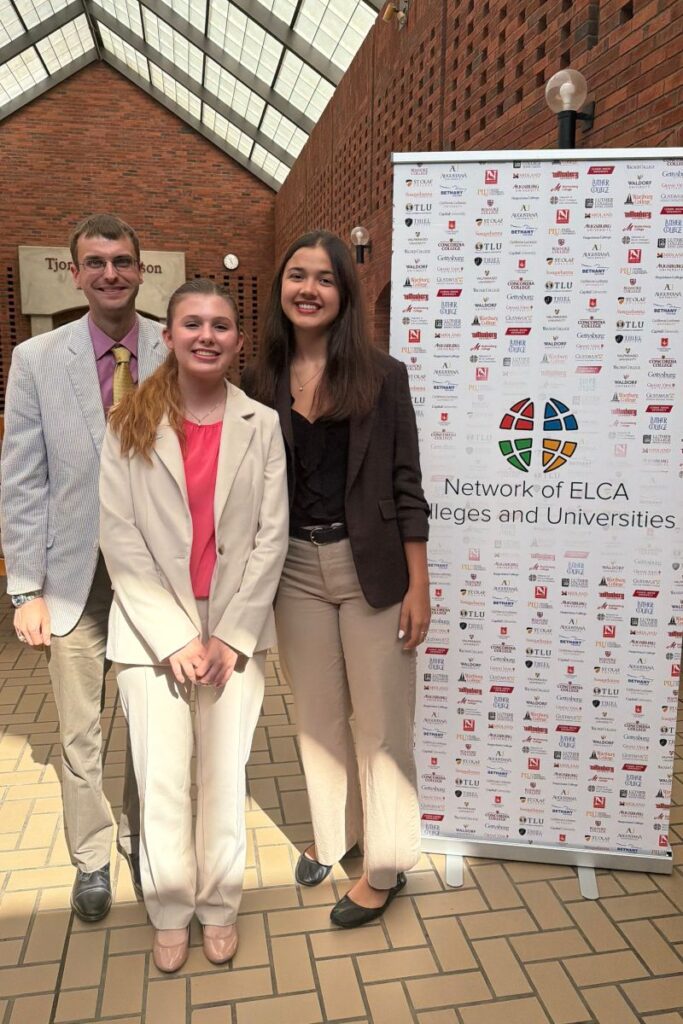
The Vocation of Lutheran Higher Education (VLHE) conference has long featured engaging presentations on topics that impact university and student life. For the first time in recent memory, student voices were directly included in the conference with sophomore English and theology double major Emma Bohmann and junior communication studies and political science double major Andie Lozano-Lomeli presenting a session alongside Dr. William O’Brochta, the Hugo & Georgia Gibson Endowed Assistant Professor of Political Science and Chair of the Department of Political Science.
The path toward being invited to present their session titled “Sustaining Campus as a Civic Community” started last fall when O’Brochta organized a civic engagement and faith perspectives conference at TLU (https://www.tlu.edu/news/a-meeting-of-minds-civic-engagement-and-faith-perspectives-conference). Lozano-Lomeli presented at the conference on her scholarship on civic engagement, and Bohmann contributed a reflection on her experience attending the conference that was later published in a special volume of Intersections on the conference that O’Brochta edited (https://www.tlu.edu/news/finding-intersections-tlu-contributes-to-necu-magazine).
After the special issue was published, one of the conference organizers, Rev. Dr. Colleen Windham-Hughes, reached out to O’Brochta to invite him to present at the VLHE conference. “I immediately wanted to invite Andie and Emma to present with me because the presentation topic focuses on students-as-partners in developing democratic decision-making on campus that then leads to civic engagement off campus,” O’Brochta said. Thanks to Windham-Hughes’s enthusiasm at the co-created presentation and the support of the Brandes Fund for Religious Activities, the group traveled to Minneapolis and presented the session twice.
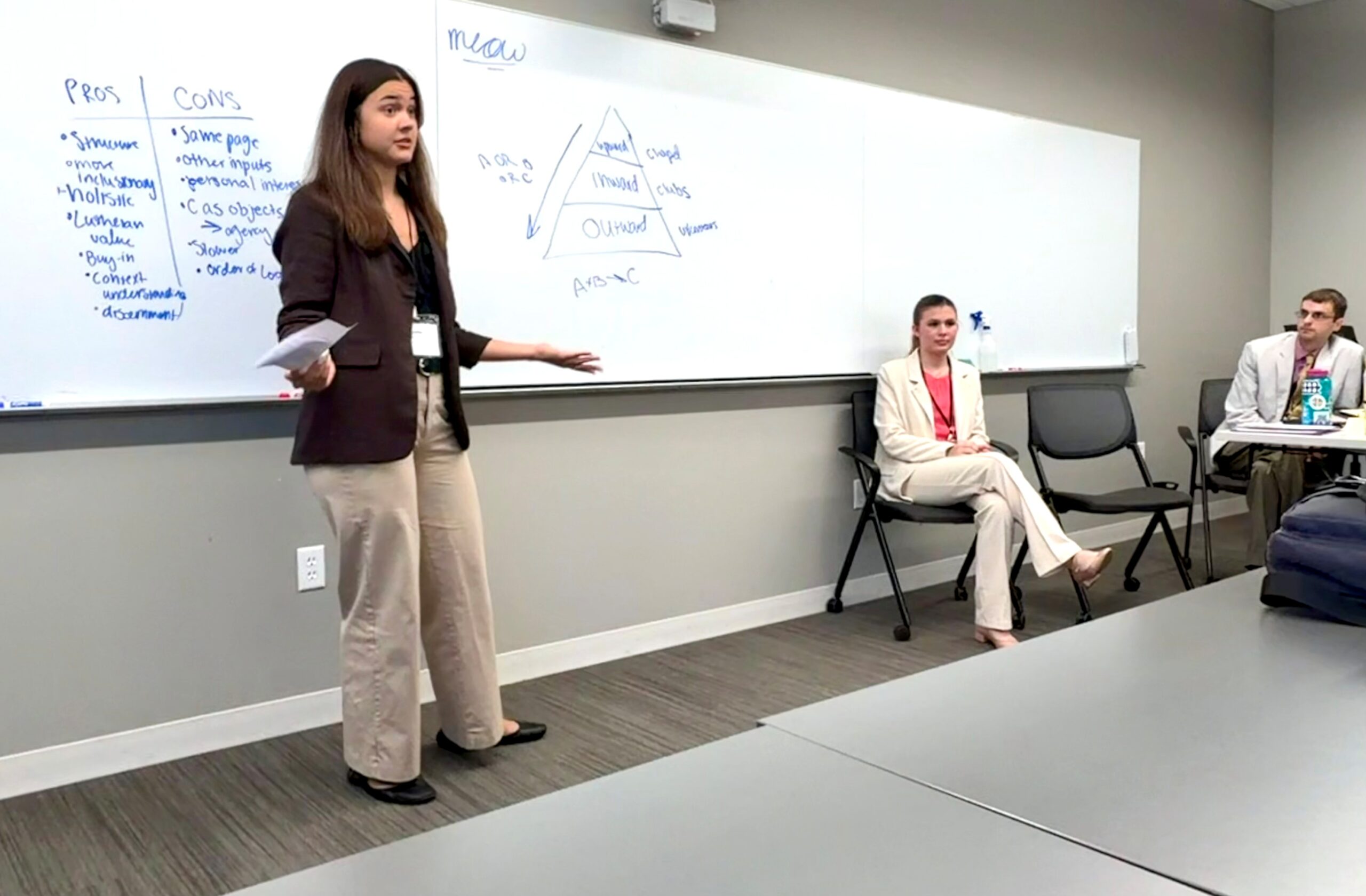
The presentation began with a theological framework for holistic Christian civic engagement based on a model that Bohmann learned about in a congregational context. “The model is called ‘upward, inward, and outward,’ and the point is that each piece represents an area in which an individual may be involved in their life: upward describes interactions with the Divine, inward with close community (such as family, friends, and congregation), and outward with larger civic community,” Bohmann said.
Bohmann then connected the model to the college campus context, specifically NECU (Network of ELCA Colleges and Universities) institutions. “First, while many institutions place a strong emphasis on one of the three areas, the model is more productive when all three areas work in conjunction with the other two. That means that whatever is discovered in spiritual education must also be translated well to the inward communities and outward civic spaces. Second, each area of the model must be fully reflective of the students-as-partners approach (which includes both a clear invitation for participation and an ongoing accompaniment through the co-creation process) so that each student feels a sense of buy-in. Essentially, each step of the ladder must be democratic in nature. Finally, we suggest that the model most naturally flows from the top-down; when spiritual engagement inspires a call to civic action, students feel the need to discuss and deliberate about this vision with peers and mentors in close-knit community, and at that point they may feel empowered to implement this vision in their on- or off-campus civic community.”
Lozano-Lomeli then led the application section, where she provided examples from TLU and invited the audience to brainstorm in small groups what it meant to include students-as-partners in cultivating on-campus civic engagement. “Many participants said that Emma and I presenting positively contributed to the learning atmosphere, making it so ideas being presented could not only be conceptualized through the lens of students, but also applied. This is why the presentation was so successful, as I felt universities had the opportunity to consider students-as-partners in a civic space through the lens of civic engagement, while listening to actual students present the idea,” Lozano-Lomeli said.
Both students reflected on their experience after the presentation. Bohmann said, “As I begin to spend the next three years of my undergraduate career discovering which context of ministry it is in which I am best fit to work, I found exposure to the high concentration of ministers from many diverse ELCA institutions to be an invaluable part of understanding my vocational path. Further, much of what we heard faculty and staff from other colleges and universities express was reflective of issues that we also experience and often see as unique to TLU. So, simply hearing that these pain points and concerns are not, in fact, unique means that they are also not unsupported or unsolvable. This also, I believe, created a renewed sense of responsibility for students, faculty, and staff at TLU; if we benefit from a common understanding of Lutheran identity in being a member of NECU, we must also take action steps to ensure that our Lutheran identity is recognizable and valued.”
“The conference served as a reminder that TLU is a Lutheran institution, and we are better off for it,” Lozano-Lomeli said. “One frame that served me was seeing Lutheran values as an opportunity to embrace key features like vocational education and the insistence of inclusion on our campus. Having the time to discern my vocation with my peers and professors shifted my focus and gave me clarity on what it means to be an advocate and to intentionally practice advocacy. Dr. O’Brochta chose to include Emma and me to be in this space, and that inclusion reflects the idea of students-as-partners, making our existence in the space an immediate example to other institutions on how to apply the concept. This opportunity can be reflected across our university, and I look forward to seeing students intentionally being included as partners.”