


The study of theology at TLU prepares students for career paths in which spiritual sensitivity, a well-tuned moral compass, interfaith understanding, and critical engagement with religious texts and traditions are required. Our majors go on to serve as pastors and youth ministers, lead non-profits, teach at private schools, work as counselors and therapists, engage in social activism, attain advanced degrees, and pursue countless other paths.
Faith in Action: Campus Ministry
Theology majors come from diverse denominational backgrounds and have varying forms of personal religious commitment, including none at all. For interested students, TLU’s campus ministry program serves as a laboratory for putting faith commitments and theological paradigms into practice.
BA in Theology
The theology degree plan invites students to construct an academic path that will prepare them for the future they envision. We offer six possible concentrations within the major.
Specializations
Customize your Bachelor of Arts in Theology by choosing a specialization that aligns with your interests, career goals, and calling.
General Studies
With the fewest hours required, this concentration is intended to facilitate double major
Pre-Seminar
Involving coursework in biblical Greek, this concentration is for students who intend to seek ordination in a denomination requiring a graduate degree in theology.
Social Change
This concentration incorporates coursework in social innovation and entrepreneurship and/or communications to empower students to become change-makers through activism.
Worship Arts
Drawing on coursework in music and/or dramatic media, this concentration helps students cultivate their artistic gifts for use in worship contexts.
Youth Ministry
A longstanding strength of TLU, this concentration gives students the practical knowledge and experience needed to serve as youth ministers / directors of faith formation in local congregations.
Pre-Counseling
This concentration incorporates coursework in psychology to help students prepare for graduate programs with a view to becoming therapists.
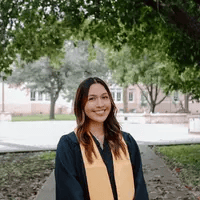
TLU’s Victory Bell rang loud and clear this past December—because Selah Flores, who’d been waiting until she’d completed her very last final to ring it, finally got her chance. “It was a very celebratory and nostalgic moment for me!” A few days later, Flores officially received her BA in Theology.
But what leads a classically trained pianist studying music performance to decide to seek a degree in theology—and what do the two pursuits have in common? Flores holds the answer to that question.
She was a competitive pianist on the national level by age twelve—has even performed at Carnegie Hall—and has a deep love for the way a musician can infuse her own personality into a piece, taking the listener into the story and evoking a range of emotions. Her love of music led her to double major in piano performance and theology early in her college career. But that path soon evolved. “During my Intro to Theology class with Dr. Amanda Kaminski, I quickly learned that the work of theology can be a profoundly non-discursive and non-dogmatic practice, often relying on techniques like question-asking, contemplation, music, and stillness.” That realization led Flores to focus solely on theology as her major, “because it combines both passions in my pursuit of justice, expression, and thoughtful re-narrativization.”
Flores has a gift for connecting the timeless truths within a piece of music to ministry. “What I love most about music and theology is the art of painting classics with the colors of today: from painting Chopin’s nocturnes as an ode to the sleepless nights of displaced families across the world to painting the story of the Samaritan woman in light of increasing sexual abuse cases within faith communities.”
Her senior capstone project stands as a perfect example of this mingling of her own passions with the important work of ministry. After caring for her grandmother, who was also her dearest friend, in the months before she passed away, Flores was inspired to study the idea of trauma-informed spiritual care for institutionalized older adults. “I proposed the integration of lament prayer into pastoral palliative care services.” In the midst of what she calls an unrecognized epidemic of toxic positivity in these settings, Flores observed that, “For patients experiencing spiritual distress, the Book of Lamentations breathes the same air of destruction, uncertainty, sorrow, and pain—thereby providing the ideal grounds for patients to receive empathy, guidance, and reminders of God’s solidarity with sufferers.” Rather than denying the pain and grief of the situation, those who are suffering are allowed to feel it all—and to find comfort in the fact that they are not alone.
During her years at TLU, Flores found the small class sizes to be especially helpful, allowing professors to become mentors and lifelong colleagues, and inspiring community-building between classmates “who are now family.” Flores adds that, “the theology department is unmatched; their insight, curiosity, scholarship, and kindness have blessed me profoundly these last few years.”
So where will she go from here? She’s been awarded a scholarship to attend the Brite Divinity School at Texas Christian University, where she will pursue her master’s degree in divinity beginning next fall. But that’s only the beginning. Inspired by her grandmother, Flores plans on training to
become a hospital chaplain, focusing on palliative care settings. “I plan to collaborate alongside healthcare staff to create effective spiritual care practices for patients experiencing spiritual distress near the end of life.” Flores is already reimagining how the Christian faith can be utilized “as a vehicle for healing, restoration, mutuality, and compassion in these spaces that hear the most unabashed expressions of sorrow.” Then one day, she hopes to go a step further, transforming her experiences as a chaplain into a curriculum designed to help other theology and healthcare professionals to learn the same important lessons. “I am passionate about cultivating creative avenues for discussing and contemplating God, and I can’t wait to see all the ways I will be able to do this in the future!”
Personal Creed
Ashley Blueyes
Diné believe in Hózho;
To exist in peace, beauty, balance, and harmony.
Living as one with the world because she gives life.
She gives us water, trees to build, animals for pelts and food.
She has given us all we have.
Shinadéé t’áá ałtso hózho.
I do not believe in heaven or hell.
Therefore, I do not believe there is a reward for leading a good life and treating others well.
I do so because I have been raised with those values.
I will be a teacher,
I will provide safe spaces to children.
What good is it to be ugly in a world where good is hard to find?
Natives give what we have;
Knowledge, water, food.
There was a time when we had everything stripped away,
When the government took what we had:
Our hair, jewelry, clothes, ceremonies, children, and lives.
We persevered by giving to one another.
Our communities were all we had.
So now we give what we have.
Personal Creed
Terry Barnes
I believe in lifting those who feel lost or left behind.
I once struggled to find purpose but found joy in serving.
I exist to inspire, to spark hope in others.
I believe forgiveness opens the door to growth.
My history is a reminder of where I’ve been.
The pain of the past teaches me to strive for change
I believe in perseverance, even when the road is hard.
Theater reminds me we can become more than we are;
track shows me strength in struggle.
Through my gifts and struggles, I grow stronger and more connected.
I believe love can transform the world if we let it.
I will show love, so others know they are more than their mistakes.
The Spirit shapes me into the likeness of Jesus.
Judged by God, I am set free by His grace.
Love—romantic, platonic, and divine—is the heart of my identity.