

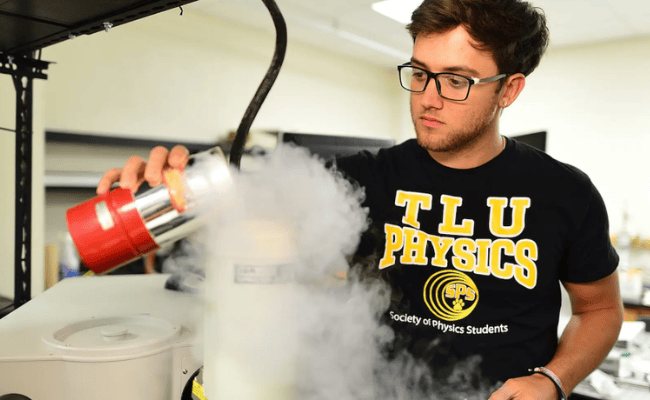
Physics is the most fundamental of all the natural sciences, aimed at understanding all parts of the natural world. In fact, the word “physics” stems from the Greek word phyusika, which translates to “natural things.” Students in physics degree programs learn the basic principles that govern the natural world and how to extend and apply those principles to solve new problems through experiment and mathematical analysis.
Small class sizes and a dedicated faculty allow TLU physics students to thrive and grow as learners. Introductory laboratories are designed to bolster both content knowledge and practical skills. Several advanced labs, including a unique computational methods course sequence, allow students to hone experimental and computational skills. Students are encouraged to participate in faculty-mentored independent research early on, and all students are required to complete a senior capstone research project. As part of the complete undergraduate experience, all students are encouraged to seek out one of many summer research or internship opportunities that host physics students around the U.S.
Students in physics are curious about how the universe works from the nano-scale interactions of biological systems to the mysteries of dark matter. At TLU Physics, our attention to the individual student allows that curiosity to manifest in a variety of ways, accommodating a vast range of career goals. Students with degrees in physics work in any field which values critical thinking skills, mathematical dexterity, analysis, and creative problem solving. You will find physics degree holders in all areas of science and technology-related careers, as well as business, medicine, law, and even economics.
Dual Degree Engineering Program
TLU is an official affiliate of the Washington University (WashU) McKelvey School of Engineering in St. Louis, Missouri. Our students study at TLU for three years in the Bachelor of Science in Applied Physics program, then spend two years at WashU to complete both the bachelor degree in Applied Physics and a bachelor degree in Engineering in one of nine engineering majors including:
- Biomedical Engineering
- Chemical Engineering
- Computer Engineering
- Computer Science
- Data Science
- Electrical Engineering
- Environmental Engineering
- Mechanical Engineering
- Systems Science & Engineering
TLU students choosing this option will complete a minimum of 100 credit hours at TLU with a cumulative GPA of 3.25 or higher in math and science coursework.
Students from affiliate schools are also eligible to receive a discount for the January Intensive Term (J-Term), a special 11-day intensive format where students study and live together and get a head start at building connections before enrolling as dual degree engineering students.
For information on how to apply, admissions criteria, application deadlines, financial aid, housing, and WashU’s J-Term, visit engineering.wustl.edu/dualdegree
Why Physics at TLU?
At TLU, physics students meet the challenges of understanding the natural world with small class sizes, hands-on laboratory experiences, and an active student-centered learning community. The TLU Physics faculty is committed to providing an engaging curriculum in the classroom, and faculty-mentored, open-ended research opportunities outside the classroom. Our unique computational physics sequence includes instruction in widely used software applications for modern engineering and applied physics. Students will participate in the broader professional scientific community in Texas and around the U.S by attending regional and national scientific meetings.
Our students are working as engineers at companies in the intelligence/defense, environmental, energy, automotive, and aerospace industries such as: Applied Materials, HP, L3 Technologies, Lasertec Corporation, National Insurance Crime Bureau (NICB), Navistar, RavenVolt Inc., Samsung, SRC, Inc., and Tesla.
Major in Physics
Bachelor of Arts (BA)
The B.A. in Physics provides a strong foundation in physics while allowing greater flexibility for students to combine physics with interests in other disciplines. It is well suited for students pursuing careers in education, business, law, medicine, public policy, science communication, or other fields where analytical and quantitative skills are valuable.
Major in Physics
Bachelor of Science (BS)
The B.S. in Physics provides a more rigorous and comprehensive preparation in physics, mathematics, and scientific problem-solving. It is designed for students seeking careers in science, engineering, technology, research, and other technical fields, as well as those planning to pursue graduate study in physics, engineering, or related disciplines.
Major in Applied Physics
Bachelor of Science (BS)
The B.S. in Applied Physics bridges the gap between physics and engineering by emphasizing the application of physical principles to real-world problems. Students gain experience in laboratory techniques, instrumentation, computation, and design through hands-on coursework and a senior capstone project. Graduates are well prepared for careers in engineering, advanced technology, manufacturing, research and development, and related technical fields, as well as for graduate study in engineering, applied physics, and allied disciplines.
Natural Science Course Offerings
Designed for non-math, non-science majors
- Summer A: PHYS143: Physics of Modern World Issues (with lab)
- Summer B: PHYS144: Conceptual Physics (with lab)
- Fall Term: PHYS143: Physics of Modern World Issues (with lab)
More About Physics at TLU
TLU physics students are encouraged to explore faculty-mentored research opportunities in the first year of their physics experience. Our advanced lab courses hone the experimental skills needed to carry out more advanced laboratory work, while our computational methods courses provide the software foundations that are common in many laboratory settings. Laboratory work leads to the senior capstone experience where students work on a year-long (or more) independent project with a faculty mentor that culminates in a senior thesis and presentation at a professional conference. TLU students are active in state and national level professional scientific meetings.
Students are encouraged to explore the wide range of summer opportunities offered by universities and industrial companies around the U.S. TLU students have participated in research at Texas A&M, University of Pennsylvania, University of Nebraska-Lincoln, Duke University, and University of Florida, among others. Participation in research at other institutions or companies can be used as the basis for the senior capstone research work.
Excelling in physics requires development and expertise in a very broad skill set. Combined with the liberal arts education at TLU, the physics department provides graduates with a highly employable blend of skills, such as problem-solving, computer programming, experimental design, technical writing, oral presentations, independent research, and teamwork. Many professions rely on these skills, which is why they are the very foundation of the physics curriculum.
Our students are working as engineers at companies in the intelligence/defense, environmental, energy, automotive, and aerospace industries such as:Applied Materials, HP, L3 Technologies, Lasertec Corporation, National Insurance Crime Bureau (NICB), Navistar, RavenVolt Inc., Samsung, SRC, Inc., and Tesla.
Our students go on to pursue engineering degrees at the following institutions:Purdue University College of Engineering, Rice University, Texas A&M University Cyclotron Institute, Texas A&M Univeristy College of Engineering, University of Colorado Boulder College of Engineering & Applied Science, University of North Texas College of Engineering, University of Texas at Austin Statistics and Data Sciences, and the University of Texas San Antonio College of Engineering.
Here is a small sampling of the kind of careers physics majors might pursue upon completing their bachelor’s (statistics from the AIP and NIH websites):
- Academia: According to the National Institutes of Health, individuals who earn a bachelor’s degree in physics commonly pursue remarkably diverse educational and career paths. There are three predominant paths immediately pursuant to obtaining the bachelor’s degree: attend graduate school in physics (32 percent), attend graduate school in other fields (20 percent), and enter the workforce (48 percent). For most physics graduate programs, schools pay tuition plus a stipend (actual numbers can be found at gradschoolshopper.com). In return, students are expected to research and/or be a teaching assistant. A master’s in physics typically takes two to three years, while a Ph.D. in physics takes about five to six years.
- Medical School: Students with a degree in physics routinely score higher than biology majors on the MCAT, the entrance exam for medical school. Students wishing to go to medical school with a physics degree are strongly urged to at least also minor in biology.
- Engineering: This is the largest field of employment for physics majors. The problem solving skills developed through coursework in physics are highly sought after in this field.
- Consulting: Many companies hire consultants to assist in solving problems with their company. The development of problem solving for a physics major makes this an ideal match.
- Law: Physics majors are continually the top-scoring major on the LSAT, the entrance exam to law school. Many companies hire physicists to be expert witnesses when scientific information needs to be explained to a jury.
- Teaching: There is a need for high school physics teachers. In 2009, only 35% of high school physics teachers have a degree in physics or physics education. Increasing the number of high school teachers with an interest in physics will increase the morale, perception and prestige of the field.”
TLU Physics has a nationally recognized chapter of the Society of Physics Students (SPS). SPS is a national organization devoted to enhancement of the undergraduate physics experience. The TLU SPS chapter serves as the hub for community building and professional development within the department of physics through strong student leadership and dedicated faculty support.
The TLU SPS meets weekly on Tuesdays at lunchtime. Each meeting of the SPS includes a program aimed at enhancing the curricular experience of students and provides an opportunity for students to self-determine the function and activities of the group. The TLU SPS chapter leads the department in a number of civic engagement and community outreach projects, including the annual Family Physics Night event, which brings over 300 visitors to the TLU campus for a public physics lecture, physics demonstrations, and interactive physics activities. All students are encouraged to become active members of SPS.
- Physics Math 7-12 Education BS
- Physics Physical Science 7-12 Education BS
- Physics Computational BS
- Physics BS
- Physics BA
- Physics Applied Computational BS
- Physics Applied BS
Since 2013, the TLU physics department and SPS have invited families and aspiring physicists of all ages to campus for live interactive demonstrations of the basic principles of physics. This serves as a fun, educational night for prospective students to learn more about the physics program at TLU and to get great ideas for science fair projects.
The evening kicks off with the SPS Public Lecture in Physics followed by refreshments at Jackson Park Gazebo. Before heading into the Jackson Park Student Activity Center, attendees enjoy an explosive Phenomenal Physics Demo Show. Inside the activity center, participants have fun learning through interactive, hands-on stations packed with fun activities for scientists of all ages.
Previous distinguished SPS Public Lecture in Physics speakers include Regents Professor of Atmospheric Sciences and Texas State Climatologist Dr. John Nielsen-Gammon, NASA Flight Engineer Dr. Renee Horton, Deputy Director of the Exploration Integration and Sciences Directorate at NASA Ginger Kerrick, and Dr. Frances Slakey.
Physics in the News
(2023) Houston-native Keslyn Stonum is one of only 31 African American students majoring in physics or astronomy nationwide to receive a TEAM-UP Together (TU-T) scholarship totaling $10,000. The award provides direct funding to scholars and physics and astronomy departments for initiatives focused on ensuring African American undergraduates thrive and obtain their degrees.

The TEAM-UP Together awards are part of the multimillion-dollar scholarship program that provides direct funding and support to African American undergraduate students majoring in physics and astronomy. A collective action initiative, TEAM-UP Together is a partnership between the American Association of Physics Teachers, the American Astronomical Society, the American Institute of Physics, the American Physical Society, and the Society of Physics Students.
Stonum, a junior double majoring in Physics and Chemistry, participates in faculty-led research projects and is a member of TLU’s Society of Physics Students chapter.
“I chose to study physics to have a basic understanding of the world around me,” she said. “To me, the TU-T scholarship is an assurance that African American physicists and astronomers belong in the physics and STEM community.”
TLU Physics Department Chair Dr. Toni Sauncy says the AIP TEAM-UP Task Force to Elevate African American Representation in Undergraduate Physics and Astronomy project represents years of critically important work for understanding how higher education can best support and encourage African American students in physics and increase the disproportionately small numbers of students who complete bachelor’s degrees in Physics or Astronomy.
“The final report of the TEAM UP Task Force presented a compelling case for actions that should be taken to accomplish those goals,” she said. “Not only is the report chock full of photos of TLU students, TLU has awarded a larger-than-average number of Physics and Applied Physics degrees over the past decade to African American students who have gone on to successful careers in physics and engineering. This award is recognition that our relatively small physics program attracts, supports, and retains strong and competitive students like Keslyn who compare well with students from across the nation. As one of only 31 students awarded in this inaugural project, it is a real recognition of her potential.”
“These students have demonstrated their passion and drive for physics and astronomy, and we are thrilled to celebrate their achievements while helping to ease some of their financial burden,” said Arlene Modeste Knowles, TU-T project manager. “This is an exciting step toward our goal of doubling the number of African American students earning bachelor’s degrees in physics and astronomy by 2030.”
For decades, the percentage of African Americans earning degrees in physics has been egregiously and persistently low—reaching just three percent in 2018 according to an AIP survey. To address this issue, TU-T is comprised of two programmatic elements. The initiative supports students throughout their undergraduate journey and academic departments who implement programs to effect systemic change.
In addition to direct funding, this game-changing, equity-focused initiative will provide undergraduate scholars mentorship, research experiences, and a supportive community in which to thrive academically and to connect with others.
Awardees come from undergraduate institutions across the country, including seven Historically Black Colleges and Universities and one Predominantly Black Institution. Ten of the students are majoring in astronomy and astrophysics-related disciplines, while 21 are physics majors.
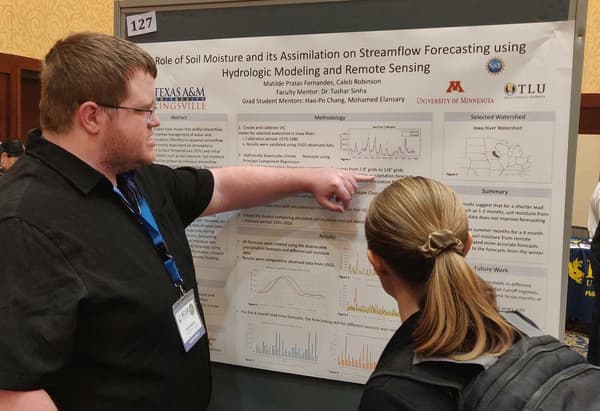
(2023) Computer Science and Data Analytics major Ty Edwards and Physics major Caleb Robinson recently represented TLU at the National Conference on Undergraduate Research (NCUR), hosted by the University of Wisconsin-Eu Claire. Along with their trip sponsor, Assistant Professor of Math, Computer Science, and Information Systems Dr. Ridwan Noel, the students joined 3,500 other undergraduate researchers and faculty. This unique conference experience featured research presentations, performances, roundtable sessions, and film projects from a variety of academic disciplines.
Dr. Noel says both students received valuable feedback from their peers and other professors.
“It was also a good networking experience for all of us,” he said. “I appreciate the opportunity and would like to thank everyone involved for making our participation possible. I am proud of the students’ achievement and hope to see TLU participate even more at future NCUR conferences.”
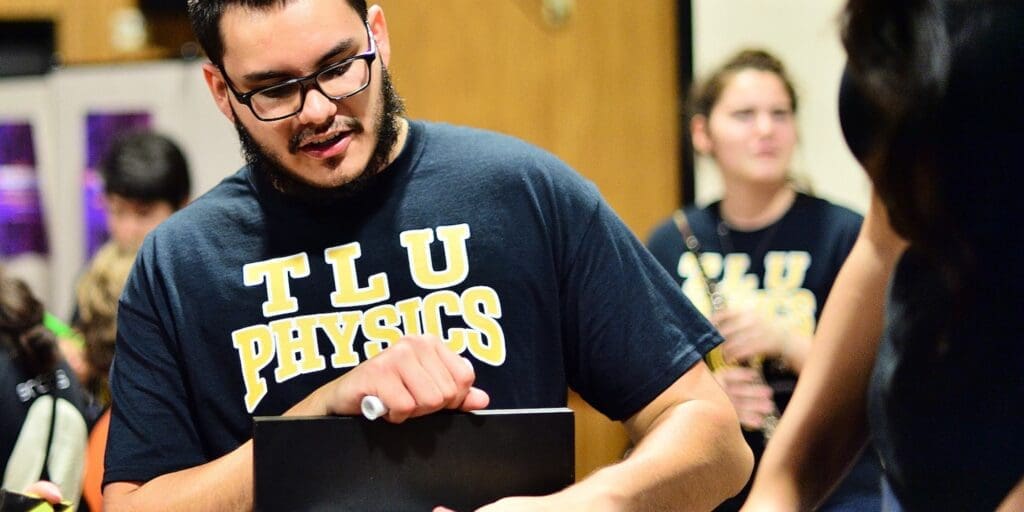
(2022) The Evangelical Lutheran Church in America (ELCA) has awarded Junior Alexander Pantoja a Thomas D. Rossing Physics Scholarship for 2022-2023 totaling $5,000. Each year, the ELCA less than 15 of these competitive awards for recognition of excellence in physics among undergraduates within their network of 26 colleges and universities. The scholarship demonstrates the ELCA’s support for academic excellence as it conveys confidence, as well as the inherent value of physics departments at affiliated schools at liberal arts institutions with smaller physics departments.
Dr. Rossing began his academic career as a professor at St. Olaf College, where he became chair of the physics department, and later continued at Northern Illinois University. Now retired, he continues to teach part-time at Stanford University. He established the scholarship in 2005 to recognize the best and brightest undergraduates across the ELCA college network while simultaneously helping to increase the amount of financial aid they receive.
After graduation, Pantoja plans on earning his master’s degree and going into the engineering field. He also wants prospective students to understand they can be successful in challenging disciplines in different areas of STEM.